

How To Set Aperture On Film Camera
It is difficult to take good pictures without having a solid agreement of ISO, Shutter Speed and Aperture – the Three Kings of Photography, besides known as the "Exposure Triangle". While well-nigh new DSLRs take "Auto" modes that automatically pick the right shutter speed, aperture and fifty-fifty ISO for your exposure, using an Auto mode puts limits on what yous can achieve with your photographic camera. In many cases, the camera has to judge what the right exposure should exist by evaluating the amount of low-cal that passes through the lens. Thoroughly understanding how ISO, shutter speed and aperture piece of work together allows photographers to fully take charge of the situation past manually controlling the camera. Knowing how to arrange the settings of the camera when needed, helps to get the best out of your camera and push information technology to its limits to have great photographs.
Let's quickly review a summary of the Exposure Triangle as a refresher:
- Shutter Speed – the length of time a photographic camera shutter is open to expose light into the camera sensor. Shutter speeds are typically measured in fractions of a second, when they are under a second. Deadening shutter speeds allow more lite into the photographic camera sensor and are used for low-light and nighttime photography, while fast shutter speeds help to freeze motion. Examples of shutter speeds: 1/fifteen (1/15th of a second), 1/30, i/sixty, one/125.
- Aperture – a hole within a lens, through which low-cal travels into the camera body. The larger the hole, the more lite passes to the camera sensor. Aperture as well controls the depth of field, which is the portion of a scene that appears to be abrupt. If the aperture is very small, the depth of field is large, while if the aperture is large, the depth of field is small. In photography, aperture is typically expressed in "f" numbers (likewise known every bit "focal ratio", since the f-number is the ratio of the diameter of the lens aperture to the length of the lens). Examples of f-numbers are: f/1.4, f/ii.0, f/2.8, f/four.0, f/5.6, f/8.0.
- ISO – a way to burnish your photos if you can't use a longer shutter speed or a wider aperture. It is typically measured in numbers, a lower number representing a darker epitome, while higher numbers mean a brighter image. However, raising your ISO comes at a cost. As the ISO rises, so does the visibility of graininess/racket in your images. Examples of ISO: 100, 200, 400, 800, 1600.
Also, take a look at this article if yous would like to understand what exposure actually means.
And if y'all're more of a visual learner, we recently published a comprehensive, beginner-friendly video on this verbal same topic:
1) How Do Shutter Speed, Aperture and ISO Work Together to Create an Exposure?
To have a good understanding almost exposure and how shutter speed, aperture and ISO affect it, nosotros demand to understand what happens inside the camera when a picture is taken.
Every bit you bespeak your camera at a subject and press the shutter push button, the bailiwick gets into your photographic camera lens in a form of light. If your subject is well-lit, there is plenty of calorie-free that travels into the lens, whereas if you are taking a picture in a dim environs, there is not much calorie-free that travels into the lens. When the light enters the lens, it passes through various optical elements made of glass, so goes through the lens "Aperture" (a pigsty inside the lens that tin be inverse from pocket-sized to large). Once the low-cal goes past the lens aperture, it then hits the shutter drape, which is like a window that is closed at all times, but opens when needed. The shutter then opens in a matter of milliseconds, letting the low-cal hit the photographic camera sensor for a specified amount of time. This specified amount of time is called "Shutter Speed" and it tin be extremely short (up to i/8000th of a second) or long (upwardly to 30 seconds). The sensor then gathers the light, and your "ISO" brightens the image if necessary (again, making grain and image quality issues more visible). Then the shutter closes and the low-cal is completely blocked from reaching the camera sensor.
To go the prototype properly exposed, and then that it is non besides bright or too dark, Shutter Speed, Aperture and ISO demand to play together. When lots of light enters the lens (allow'south say it is broad daylight with plenty of sunlight), what happens when the lens aperture/hole is very small? Lots of light gets blocked. This means that the camera sensor would demand more fourth dimension to collect the lite. What needs to happen for the sensor to collect the right amount of light? That's right, the shutter needs to stay open up longer. So, with a very pocket-size lens aperture, nosotros would need more time, i.eastward. longer shutter speed for the sensor to assemble enough light to produce a properly exposed image.
Now what would happen if the lens aperture/hole was very large? Obviously, a lot more low-cal would hit the sensor, then nosotros would need a much shorter shutter speed for the image to go properly exposed. If the shutter speed is also low, the sensor would go a lot more calorie-free than it needs and the light would kickoff "burning" or "overexposing" the image, just like magnifying drinking glass starts burning paper on a sunny solar day. The overexposed area of the prototype will look very vivid or pure white. In contrast, if the shutter speed is way too loftier, then the sensor is not able to assemble enough lite and the epitome would appear "underexposed" or too dark.
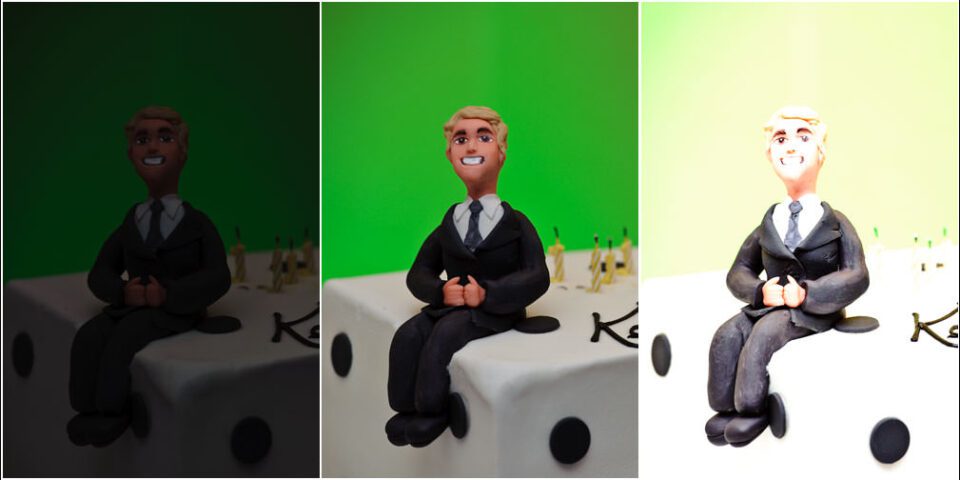
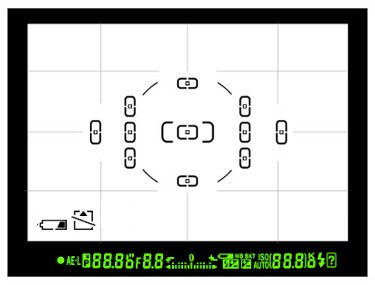
Let'due south do a existent-life instance. Grab your camera and set up your camera way to "Aperture Priority". Set your lens aperture on your camera to the lowest possible number the lens volition allow, such as f/ane.four if you have a fast lens or f/iii.5 on slower lenses. Set your ISO to 200 and make sure that "Automobile ISO" is turned off. Now point your photographic camera at an object that is Non a light source (for example a moving-picture show on the wall) and then one-half-press the shutter push to larn correct focus and let the camera determine the optimal exposure settings. Do not move your photographic camera and keep pointing at the same bailiwick! If you wait within the camera viewfinder now or on the back LCD, you should run into several numbers. 1 of the numbers will prove your aperture, which should be the same number equally what you set your aperture to, then it should show your shutter speed, which should be a number such equally "125" (ways 1/125th of a 2d) and "200", which is your sensor ISO.
Write down these numbers on a piece of newspaper and so accept a picture. When the picture comes upwards on the rear LCD of your camera, it should be properly exposed. It might be very blurry, but it should be properly exposed, which means not too brilliant or too night. Allow'south say the settings you wrote down are 3.5 (aperture), 125 (shutter speed) and 200 (ISO). Now change your camera fashion to "Manual Mode". Manually set your aperture to the same number equally you wrote down, which should be the lowest number your camera lens volition allow (in our example information technology is 3.5). So set your shutter speed to the number yous wrote down (in our instance it is 125) and proceed your ISO the aforementioned – 200. Make sure your lighting atmospheric condition in the room stay the same. Bespeak at the same discipline and take another picture. Your results should look very similar to the picture you took earlier, except this time, yous are manually setting your camera shutter speed, instead of letting your camera make the guess. Now, let's block the amount of light that is passing through the lens by increasing the aperture and see what happens. Increase your aperture to a larger number such as "8.0" and go on the rest of the settings the aforementioned. Point at the same subject and take another movie. What happened? Your image is as well dark or underexposed now! Why did this happen? Because you blocked a portion of the light that hits the sensor and did not alter the shutter speed. Because of this, the camera sensor did not take plenty time to gather the light and therefore the image is underexposed. Had you decreased the shutter speed to a smaller number, this would not have happened. Sympathize the human relationship?
Now change your aperture back to what it was before (smallest number), but this fourth dimension, decrease your shutter speed to a much smaller number. In my example, I will set up my shutter speed to iv (quarter of a 2d) from 125. Take another flick. Now your paradigm should exist overexposed and some parts of the image should announced too brilliant. What happened this time? You let your lens pass through all the light it can assemble without blocking it, then you let your sensor assemble more calorie-free then it needs past decreasing the shutter speed. This is a very basic explanation of how aperture and shutter speed play together.
So, when does ISO come into play and what does it do? Then far, we kept the ISO at the aforementioned number (200) and didn't change it. Remember, ISO means sensor brightness. Lower numbers hateful lower brightness, while higher numbers mean college brightness. If you were to alter your ISO from 200 to 400, you would exist making the phototwice as vivid. In the higher up instance, at aperture of f/3.5, shutter speed of 1/125th of a 2d and ISO 200, if you were to increase the ISO to 400, you lot would demand one-half the time to properly expose the image. This means that you could set your shutter speed to 1/250th of a second and your image would still come out properly exposed. Effort it – set your discontinuity to the same number yous wrote down earlier, use a shutter speed that is twice as fast, and then change your ISO to 400. It should await the same as the first prototype you lot took earlier. If you lot were to increase the ISO to 800, you would need to again use a shutter speed that's twice as fast, from 1/250 to 1/500.
As you tin run into, increasing ISO from 200 to 800 will allow you lot to shoot at higher shutter speeds and in this example increase it from 1/125th of a second to 1/500th of a second, which is enough of speed to freeze move. However, increasing ISO comes at a cost – the higher the ISO, the more than noise or grain it will add to the picture.
Basically, this is how the Three Kings work together to create an exposure. I highly recommend practicing with your camera more to see the effects of changing aperture, shutter speed and ISO.
two) What Camera Mode Should I Be Using?
As I pointed out in my "Understanding Digital Camera Modes" article, I recommend using "Aperture Priority" mode for beginners (although whatever other style works equally well, equally long as y'all know what you are doing). In this fashion, you set your lens discontinuity, while the photographic camera automatically guesses what the correct shutter speed should be. This mode, you can command the depth of field in your images by changing the aperture (depth of field also depends on other factors such as photographic camera to subject distance and focal length). There is absolutely zippo incorrect with using "Auto" or "Program" modes, peculiarly considering the fact that most modern DSLRs give the photographer pretty good control by allowing to override the shutter speed and aperture in those modes. But about people go lazy and end upward using the Auto/Programme modes without understanding what happens inside the camera, and then I highly recommend to larn how to shoot in all camera modes.
three) What ISO Should I Set My Camera To?
If your camera is equipped with an "Auto ISO" characteristic (known as "ISO Sensitivity Auto Control" on Nikon bodies), you should enable it, then that the camera automatically guesses what the correct ISO should be in different lighting atmospheric condition. Auto ISO is worry-free and it works great for almost lighting conditions! Set your "Minimum ISO/ISO Sensitivity" to 100 on Canon cameras and 200 on latest Nikon cameras, then set your "Maximum ISO/Maximum Sensitivity" to 800 or 1600 (depending on how much dissonance you lot consider acceptable). Gear up the "Minimum Shutter Speed" to 1/100th of a second if you lot have a brusque lens below 100mm and to a higher number if you have a long lens. Basically, the photographic camera volition watch your shutter speed and if it drops beneath the "Minimum Shutter Speed", information technology will automatically increase the ISO to a higher number, to attempt to keep the shutter speed above this setting. The full general rule is to ready your shutter speed to the largest focal length of your lens. For example, if you have a Nikon lxx-300mm f/iv.5-5.half-dozen zoom lens, set your minimum shutter speed to 1/300th of a 2nd. Why? Because every bit the focal length of the lens increases, then practise the chances of having a camera shake that will render your images blurry. But this dominion doesn't always work, because in that location are other factors that all play a role in whether you lot volition innovate photographic camera shake or not. Having shaky easily and improperly holding the photographic camera might cause extra camera shake, while having a lens with Vibration Reduction (as well known equally Paradigm Stabilization) might actually help to decrease camera shake. Either style, play with the "Minimum Shutter Speed" option and try irresolute numbers and see what works for you.
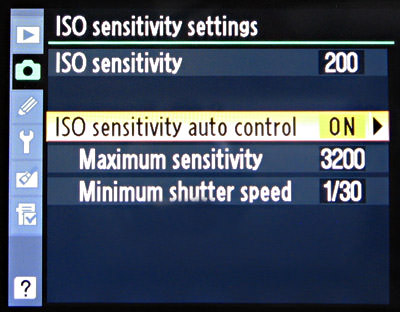
If you practise not have an "Auto ISO" pick in your photographic camera, and then start out with the everyman ISO and run across what shutter speeds you are getting. Continue on increasing the ISO until y'all go to an acceptable shutter speed.
4) Exposure Bounty
Another corking feature of all modern DSLRs, is the ability to control the exposure past using the "exposure compensation" characteristic. Except for manual fashion, exposure compensation works neat for all camera modes. Whether yous are shooting in Aperture Priority, Shutter Priority or Auto/Program modes, dialing the exposure compensation up or downward (plus to minus) will let you to regulate the exposure and override the camera-guessed settings. If you discover your image (or parts of your image) underexposed or overexposed, y'all tin use exposure compensation to adjust the exposure without manually irresolute the aperture or shutter speed.
5) Should I Use Flash or Increment ISO?
It really depends on what yous are taking a moving-picture show of. Sometimes information technology is not possible to apply your born camera flash in a low-light surroundings. For example, if your subject is standing far abroad, you might non be able to reach the subject field with your wink. In that case, the only solution is to either come closer to the subject, or plough off flash completely and utilise a higher ISO. Obviously, for landscape or architectural photography, y'all should always plow off your flash, because it volition not be able to brighten up the unabridged scene. So in a low-calorie-free state of affairs, the only two options are to either increase the ISO and then that you tin shoot hand-held, or set up the camera to the lowest ISO and use a tripod.
6) What are "Full Stops"?
Have y'all e'er heard of a term "full finish" in photography? Each of the increments between ISO numbers is chosen "a full stop" in photography. For example, at that place is one full finish betwixt ISO 100 and ISO 200, while there are two full stops between ISO 100 and ISO 400. How many stops are there between ISO 100 and ISO 1600? That's right, four full stops of light. Why practise yous demand to know about stops? Because y'all might come across it in photography literature or lensman might mention stops and information technology is sometimes disruptive to sympathise what it truly means. But the term "full stop" does non just apply to ISOs – the same concept is at that place for shutter speed and aperture. It is easy to remember full stops betwixt shutter speeds, because y'all just start from ane and divide the number by ii: 1, 1/ii, 1/iv, 1/8, one/xv, i/xxx, 1/lx, 1/125, one/250, i/500, 1/1000, etc. Obviously, the numbers are rounded (starting from 1/15, which should be ane/16) to brand information technology easy for photography. Information technology is harder to memorize stops in apertures, because the numbers are computed differently: f/1, f/1.4, f/2, f/ii.8, f/iv, f/five.half-dozen, f/8, f/11, f/sixteen, etc. To read more about stops, please see our detailed Exposure Stops article.
7) Specific Examples and Case Scenarios
Let'south now go over what you could do in your camera to properly expose an image in dissimilar lighting conditions.
-
- What should I do in low-light situations? Use Aperture-Priority mode, set your aperture to the lowest possible number. Be careful if y'all have a fast lens such every bit Nikon 50mm f/i.iv, because setting aperture to the lowest number (f/1.four) will make the depth of field very shallow. Set your "Auto ISO" to "On" (if you accept information technology) and make certain that the maximum ISO and minimum shutter speed are both defined, as shown in section 3. If after increasing your ISO you are all the same getting small shutter speeds (which ways that you are in a very dim surround), your merely other options are to either use a tripod or a wink. If y'all accept moving subjects that need to be "frozen", you volition have to use flash.
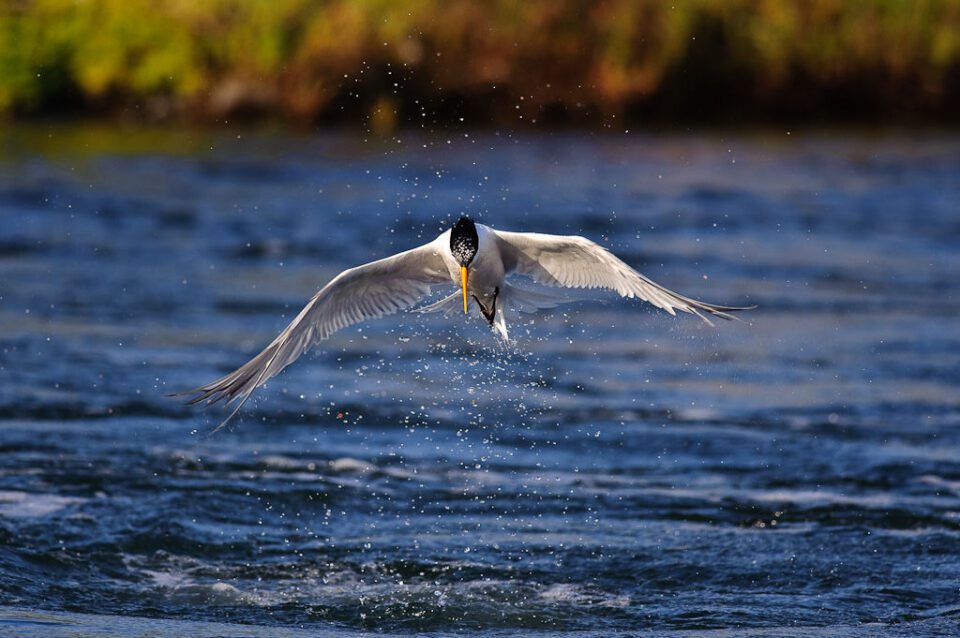
- What practice I need to practise to freeze activity? Starting time, you will need enough of low-cal. Freezing activity during the broad daylight is easy, whereas information technology is extremely tough to do information technology in low-light situations. Assuming you accept plenty of lite, make sure that your discontinuity is set to the lowest number (over again, exist conscientious almost depth of field), and so ready your "Auto ISO" to "On" (if you lot have it) and gear up your minimum shutter speed to a really high number such as 1/500th or one/1000th of a second. For my bird photography, I attempt to keep shutter speeds at 1/1000th of a 2d and faster:
- What settings do I need to change to create a motion mistiness effect? Turn off Auto ISO and gear up your ISO to the lowest number. If the shutter speed is too fast and you withal cannot create motility mistiness, increase aperture to a college number until the shutter speed drops to a low number below 1/100-ane/fifty of a 2d.
- What do I do if I cannot get proper exposure? The image is either as well dark or likewise bright. Make certain that yous are non shooting in Manual Mode. Gear up your photographic camera meter to "Evaluative" (Catechism) or "Matrix" (Nikon). If information technology is already set up and you are still getting improper exposure, it means that you are probably taking a film where there is a large dissimilarity between multiple objects (for example bright sky and nighttime mountains, or sunday in the frame) – whatever you are trying to have a picture of is disruptive the meter within your photographic camera. If you still demand to take a picture, fix your camera meter to "Spot" and endeavour to point your focus point to an area that is non too bright or too dark. That manner you go the "sweet middle".
- How tin I isolate my field of study from the groundwork and make the background (bokeh) expect soft and smooth? Stand closer to your subject and utilize the smallest aperture on your lens. Some lenses can render groundwork much meliorate and smoother than others. If you practice not like the bokeh on yours, consider getting a good portrait lens such as the Nikon 50mm f/one.4 or the Nikon 85mm f/1.4, which is considered to exist one of the best lenses when it comes to bokeh.
- How tin I subtract the amount of noise/grain in my images? Plough off "Car ISO" and set your ISO to the base ISO of the camera (ISO 100 on Canon and ISO 200 on Nikon).

How To Set Aperture On Film Camera,
Source: https://photographylife.com/iso-shutter-speed-and-aperture-for-beginners
Posted by: hansonfign1966.blogspot.com
0 Response to "How To Set Aperture On Film Camera"
Post a Comment